Diagnostic instruments
Conventional Otoscope
Web referenceTGI-C-7A4CF310Quote this to us. It identifies this page, not a factory part number.
Also called Auriscope
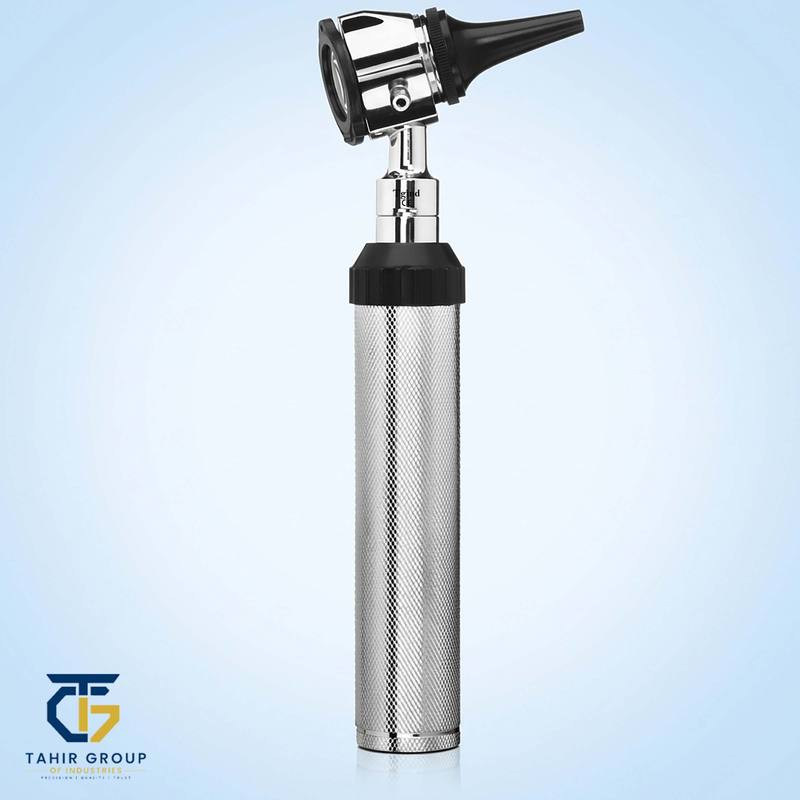
A conventional otoscope: the lamp sits in the head rather than the light being carried up to the tip by fiber optics. The handle is made in chrome plated brass and in stainless steel.
An otoscope is a hand held diagnostic instrument for examining the ear canal and the eardrum. It has no cutting or grasping end. It is built in two parts: a handle that holds the power source, and a head that carries the light source, a magnifying lens and a speculum mount. Illumination is either direct, with the lamp inside the head, or fiber optic, with the light carried from the handle up to the speculum tip so the lamp stays out of the viewing path. The head is open, called diagnostic, or closed, called pneumatic. The pneumatic head adds a sealed viewing window and a side port fitted with a rubber bulb for insufflation, which puffs air against the eardrum so the examiner can see whether it moves. An operating head leaves room between the eyepiece and the speculum tip so an instrument can be passed down the canal, usually with a lens that swings aside. The speculum is sized by the outside diameter of its tip and is made reusable in metal and single use in plastic. A mini or pocket otoscope is the same architecture built smaller, usually with a head that does not interchange and with less light.
Minimum order150 pcsThe minimum for diagnostic instruments. Mixed orders are quoted against your list.
MaterialChrome plated brass, or stainless steel
Lead timeInstruments ~2-3 weeks · full sets ~4-6 weeks after advance.
How it is built
- Two part build: a handle holding the power source, and a head carrying the optics, the light source and the speculum mount
- Direct illumination, lamp inside the head, or fiber optic illumination, light carried from the handle to the speculum tip
- Open diagnostic head, or closed pneumatic head with a sealed window and an insufflation port fitted with a rubber bulb
- Operating head: an open pattern with room to pass an instrument, commonly with a swing aside lens
- Viewing lens magnification commonly published at about 3x, within a 2x to 4x span across the trade
- Speculum at the tip, reusable in metal or single use in plastic, graduated by tip outside diameter, with pediatric and adult sizes at the two ends of one range rather than in two separate systems
- Handle built in a 2.5 V or a 3.5 V system, the higher voltage giving more light; a head and a handle are matched within one voltage family
- Mini or pocket pattern: a smaller head and handle, usually fixed rather than interchangeable, with less light output than a full size instrument
PatternsDiagnostic otoscope · Pneumatic otoscope · Fiber optic otoscope · Operating otoscope · Mini or pocket otoscope
The standard sizes this kind of instrument is made in
Reusable metal ear specula: graduated across roughly 2 mm to 5 mm tip outside diameter, with the steps differing by maker. One published range runs 2, 3, 4, 5 and 9 mm; another runs 2.2, 2.8, 3.5, 4.5 and 5.5 mm · Single use plastic ear specula: commonly published at 2.5 mm and 4 mm · Pneumatic and operating heads take a larger speculum than the plain diagnostic head, up to 9 mm in one published range · Handle systems: 2.5 V and 3.5 V. The difference is the light output, not a dimension · Viewing lens: about 3x is the figure most often published, within a 2x to 4x span
These are the sizes the pattern is manufactured in across the trade. They are not a stock list. Tell us the size you need and we will quote against it.
This describes the article. The material it is made of is printed above; it is not offered in the four steel lines.
True of every order
Instruments are marked to the buyer's requirement (TGI, unmarked, or the buyer's own brand), agreed on the order.
Customized packaging is part of what TGI supplies. Your own printed boxes, your labels, your brand on the pack, or plain export packing, whichever your market needs. The packing for your order is agreed with you and confirmed on the order.
Manufactured under the quality management system covered by TGI's ISO 9001:2015 and ISO 13485:2016 certificates. Certificate numbers and the issuer's registry are on the certification page. Open the certificates
Every batch of steel is ordered to a specified grade and arrives with the mill's own certificate, which identifies the mill and states the grade. TGI checks the material at the factory against its own requirement before it goes into production. That check is TGI's own inspection, not an independent laboratory test.
TGI manufactures in its own factory in Sialkot and also supplies articles made by contracted partner workshops, to TGI's specification. Which applies to a given article is confirmed on your order.
One-year guarantee on Premium and Executive tier instruments, hollowware and sterilization containers: any technical manufacturing defect, including material faults and rust, is replaced free of charge. Damage from handling or accidents is not covered. The year runs from the day the goods leave Sialkot.
If something is wrong with a delivery (a manufacturing defect, or a short or wrong article), tell us on WhatsApp within 7 days of delivery, with a video and photographs of what arrived. Replacement instruments are sent free of charge and dispatched within 24 hours of us seeing them; you pay the shipping, and they reach you as a normal order does.
Damage that happened after the goods left Sialkot is a claim against your carrier. The video of your parcel at the shipping office is sent to you before shipment and is the evidence that claim needs.