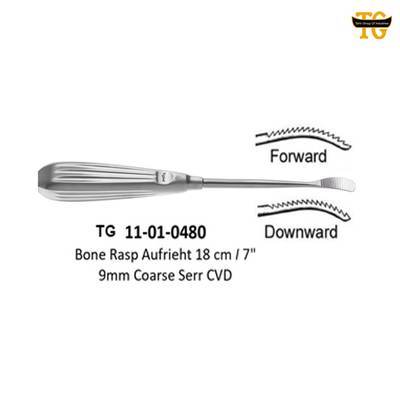
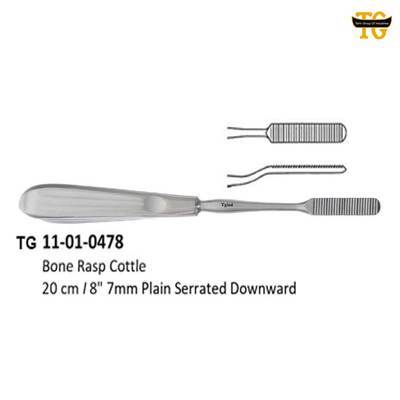
Orthopedic instruments
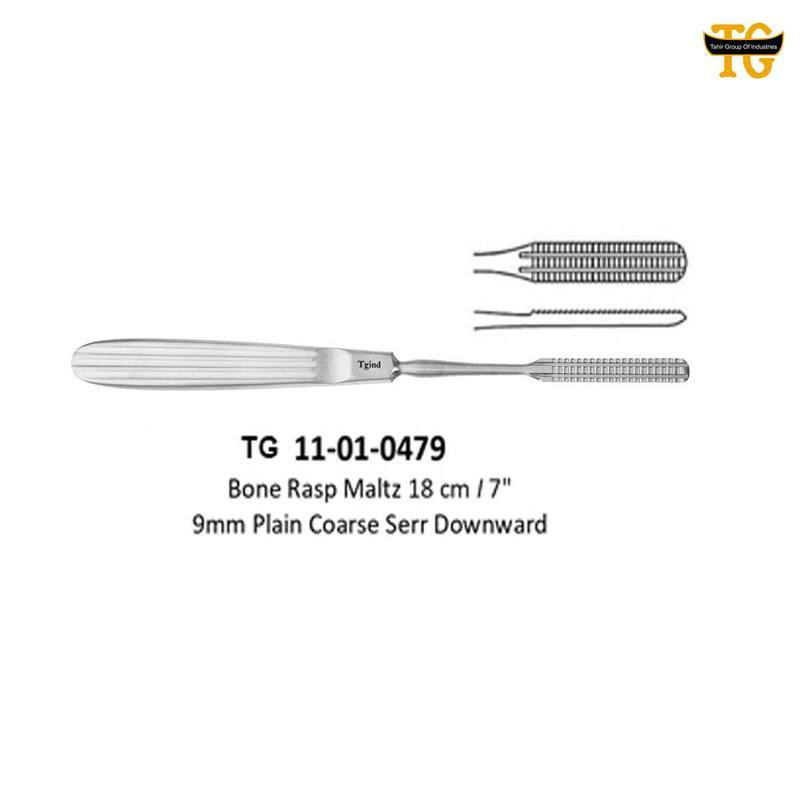
Maltz Bone Rasp
TGI referenceTG 11-01-0479Quote this to us. It is printed on TGI's own catalog photograph of this article.TGI-C-97E74B65 Web reference. It identifies this page, not a factory part number.
Sizes TGI publishes18 cm / 7" · 9mm Printed on TGI's own catalogue photograph of this article.
Also printed on the photographPlain · Coarse Serr · Downward Printed on TGI's own catalogue photograph of this article.
Also called Bone File
A rhinoplasty pattern cut for reducing and smoothing the bony nasal hump, not for filing a broad flat bone surface.
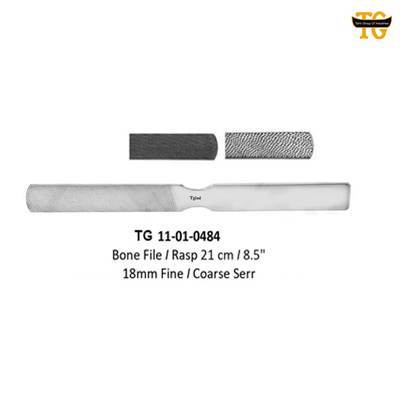
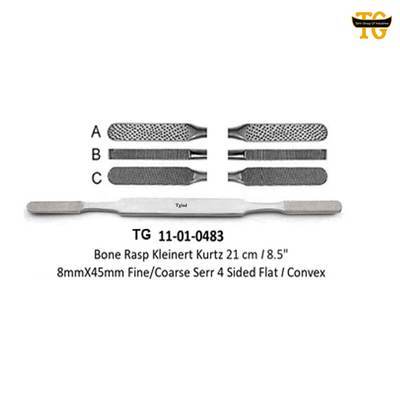
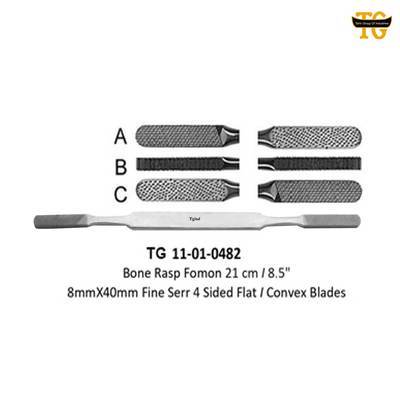
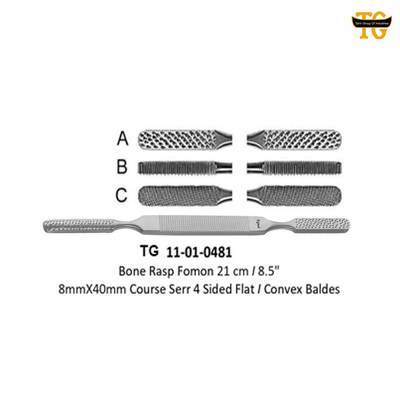
A bone rasp is a one-piece hand file for bone: a blade cut with rows of teeth, carried on a shaft with a handle, with no joint. The blade is made flat, round, half-round or convex and is usually tapered along its length. Teeth are cut either in plain rows or as cross serrations, in a coarse or a fine grade, and the pattern cuts on the push, on the pull, or on both in a double-ended form. It is ordered on three numbers: overall length, blade width, and blade form. Some patterns set the blade on a bayonet shaft so the blade is offset from the line of the handle.
Minimum order300 instrumentsThe minimum for orthopedic instruments. Mixed orders are quoted against your list.
Lead timeInstruments ~2-3 weeks · full sets ~4-6 weeks after advance.
Quality control
The inspection step is set by the line you order.
- Economy line
- sample: visual + dimensional
- Clinical line
- sample + boil test
- Premium line
- tighter sample + hardness test
- Executive line
- 100% inspection + laser mark
Finish A color is a second choice, made on top of the line. Colored finishes on request, on any instrument, in addition to the steel line. Evidenced: black · gold · rose gold · blue · rainbow (anodised titanium).
How it is built
- One piece stainless steel, no joint
- Blade flat, round, half-round or convex, usually tapered along its length
- Teeth cut in plain rows or as cross serrations; coarse and fine grades made
- Cut direction forward, backward, or forward-and-backward on double-ended patterns
- Made single-ended with a shaped handle, and double-ended with a central grip
- Some patterns use a bayonet handle that offsets the blade from the shaft line
- Ordered by overall length, blade width and blade form
PatternsPutti · Aufricht · Cottle · Joseph · Lewis · Maltz · Polokoff
The standard sizes this kind of instrument is made in
305 mm (12 in): Putti, double-ended, round and half-round tapered; round blade 10.0 mm tapering to 4.0 mm, half-round blade 15.0 mm tapering to 5.0 mm · 270 mm (10 3/4 in): Putti, double-ended, straight/curved flat tapered tips · 267 mm (10 1/2 in), Putti, double-ended · 298 mm (11 3/4 in), Putti, double-ended round and flat · 210 mm (8 1/4 in): Aufricht, 32 x 9 mm, single-ended, forward cutting · 210 mm (8 1/4 in): Aufricht, 32 x 9 mm, single-ended, backward cutting · 205 mm (8 in): Cottle, 30 x 9 mm, single-ended backward cutting, plain serrations · 160 mm (6 1/4 in): Joseph, 60 x 8 mm, single-ended, fine cross serrations · 190 mm (7 1/2 in): Lewis, 15 x 8 mm, coarse, single-ended, plain serrations · 180 mm (7 in): Maltz, 10 mm, single-ended backward cutting · 210 mm (8 1/4 in): Maltz, double-ended, forward and backward cutting · 170 mm (6 1/2 in), excision arthroplasty rasp / bone file · 170 mm (6 1/2 in), trochlear rasp / bone file · 180 mm (7 in): Polokoff, straight, double-ended, horizontal rasping, 4 mm/3 mm, 5 mm, and 6 mm/5 mm · 220 mm (8 3/4 in), 18 mm width, fine/coarse serrations · 245 mm (9 3/4 in): 13 mm width, bayonet handle, flat/convex with cross serrations · 280 mm (11 in): 20 mm width, bayonet handle, flat/tapered with cross serrations
These are the sizes the pattern is manufactured in across the trade. They are not a stock list. Tell us the size you need and we will quote against it.
This describes the bone rasp as an article. 13 other articles in this catalog share it: the sentence above is what separates this one. This describes the article. The steel, the finish and the inspection step are set by the line you order.
Material and quality
| Line | Steel | Origin | Finish | Inspection |
|---|---|---|---|---|
| Economy line | AISI 410 | Pakistani or Taiwanese | satin, passivated | sample: visual + dimensional |
| Clinical line | AISI 420 | Pakistani or German | satin, passivated | sample + boil test |
| Premium line | AISI 420-440C | German or Japanese | fine polish, passivated | tighter sample + hardness test |
| Executive line | AISI 440C | German or Japanese | mirror polish, passivated | 100% inspection + laser mark |
This is the steel each line is made from as standard. A different origin can be supplied on request (a lower grade in Japanese steel, for example), agreed on your order.
Premium is the line where the choice is yours: 420 or 440C, agreed on your order. Economy is always 410 and Executive is always 440C. Those three are the instrument steels. Hollowware and sterilization containers are made in AISI 202 on a Clinical order and AISI 304 on a Premium or Executive one, and they are not offered in the Economy line at all, which is the section above.
True of every order
Instruments are marked to the buyer's requirement (TGI, unmarked, or the buyer's own brand), agreed on the order.
Customized packaging is part of what TGI supplies. Your own printed boxes, your labels, your brand on the pack, or plain export packing, whichever your market needs. The packing for your order is agreed with you and confirmed on the order.
Manufactured under the quality management system covered by TGI's ISO 9001:2015 and ISO 13485:2016 certificates. Certificate numbers and the issuer's registry are on the certification page. Open the certificates
Every batch of steel is ordered to a specified grade and arrives with the mill's own certificate, which identifies the mill and states the grade. TGI checks the material at the factory against its own requirement before it goes into production. That check is TGI's own inspection, not an independent laboratory test.
TGI manufactures in its own factory in Sialkot and also supplies articles made by contracted partner workshops, to TGI's specification. Which applies to a given article is confirmed on your order.
One-year guarantee on Premium and Executive tier instruments, hollowware and sterilization containers: any technical manufacturing defect, including material faults and rust, is replaced free of charge. Damage from handling or accidents is not covered. The year runs from the day the goods leave Sialkot.
If something is wrong with a delivery (a manufacturing defect, or a short or wrong article), tell us on WhatsApp within 7 days of delivery, with a video and photographs of what arrived. Replacement instruments are sent free of charge and dispatched within 24 hours of us seeing them; you pay the shipping, and they reach you as a normal order does.
Damage that happened after the goods left Sialkot is a claim against your carrier. The video of your parcel at the shipping office is sent to you before shipment and is the evidence that claim needs.