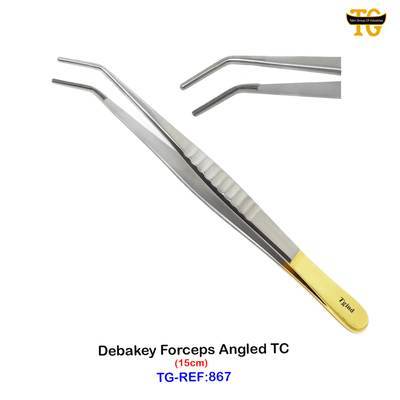
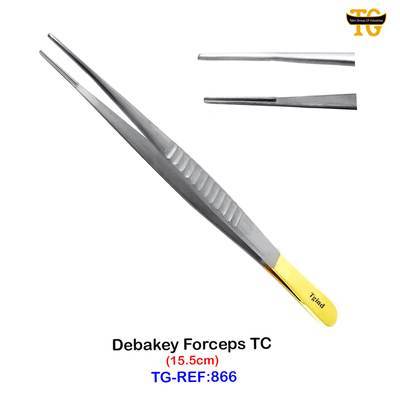
Dental instruments
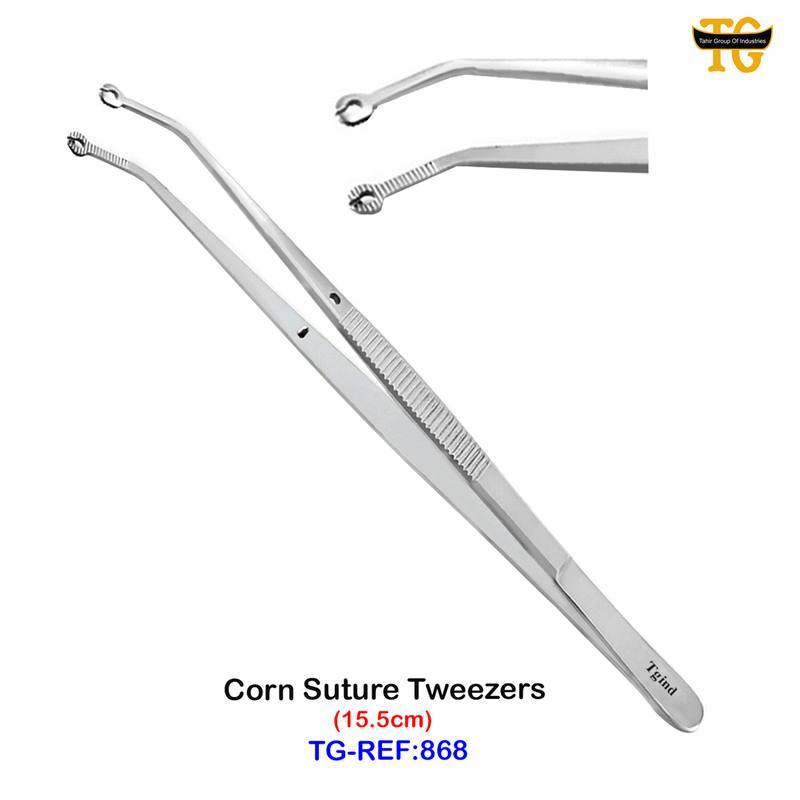
Corn Suture Tweezer
TGI referenceTG-REF:868Quote this to us. It is printed on TGI's own catalog photograph of this article.TGI-C-10D03A79 Web reference. It identifies this page, not a factory part number.
Sizes TGI publishes(15.5cm) Printed on TGI's own catalogue photograph of this article.
Also called Thumb Forceps · Dissecting Forceps
Angled, serrated beaks that hold soft tissue steady while a suture is placed, with the serrations grooved so the needle and thread pass between the jaws.
A two-armed pinching instrument made from a single strip of spring metal (or two pieces fused near the top), bent once into a narrow loop rather than pivoted on a hinge. The arms sit open under their own spring tension and close only while squeezed between finger and thumb; release the pressure and they spring back open by themselves. This is what separates tweezers from a hinged forceps, which has a pivot pin and stays wherever it is set. In the medical instrument trade the two words name the same pattern, and it is commonly sold as 'thumb forceps'.
Minimum order200 instrumentsThe minimum for dental instruments. Mixed orders are quoted against your list.
Lead timeInstruments ~2-3 weeks · full sets ~4-6 weeks after advance.
Quality control
The inspection step is set by the line you order.
- Economy line
- sample: visual + dimensional
- Clinical line
- sample + boil test
- Premium line
- tighter sample + hardness test
- Executive line
- 100% inspection + laser mark
Finish A color is a second choice, made on top of the line. Colored finishes on request, on any instrument, in addition to the steel line. Evidenced: black · gold · rose gold · blue · rainbow (anodised titanium).
How it is built
- One piece of spring metal, or two pieces fused near the top, formed into a narrow loop at one end and left open at the other to form the two arms.
- No pivot pin, screw, box-lock or ratchet, closing force comes only from the spring of the metal itself.
- The gripping tip is flat, serrated, fine-pointed or cross-hatched depending on the pattern; the rest of each arm tapers from a flat or rounded blade down to the tip.
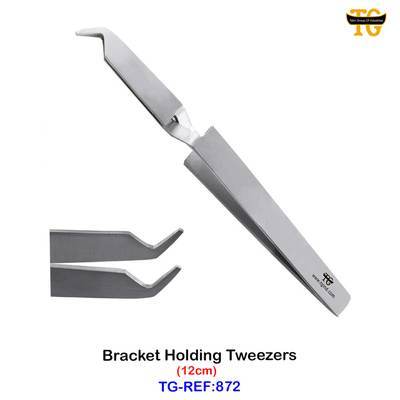
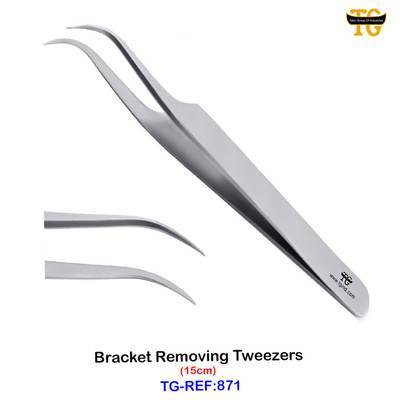
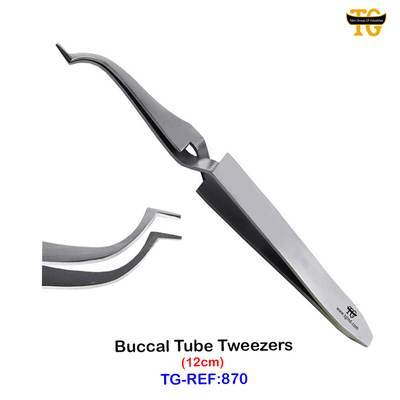
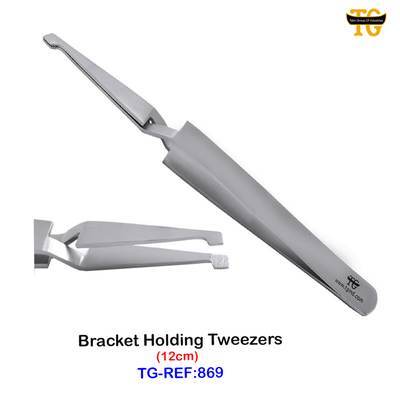
PatternsAdson (plain / smooth-tip) · Adson-Brown (fine serrated / side-grasping tip) · DeBakey (atraumatic longitudinal-serration tip) · Semken (1x2 tooth dressing/tissue forceps) · London College (dental cotton/bracket tweezer) · Bracket Holding (orthodontic bracket-placement tweezer) · Buccal Tube (orthodontic tube-placement tweezer) · Self Locking / college pattern (spring-catch cotton pliers) · Bracket Removing, real product name, no distinct published size found; usually sold as the same body as Bracket Holding/Self Locking · Mariam / Miriam, confirmed as a real trade name for a self-locking college-pattern cotton tweezer, but no explicit published size found
The standard sizes this kind of instrument is made in
120 mm (4 3/4 in), Adson-Brown pattern, 7x7 or 9x9 fine serrated (side-grasping) teeth · 120 mm (4 3/4 in), Adson Plain pattern, smooth non-toothed tips · 150 mm to 240 mm (6 in to 9 1/2 in): DeBakey pattern, length varies by maker, non-toothed atraumatic tip · 127 mm (5 in): Semken pattern, 1x2 teeth, straight or curved tip · 152 mm (6 in): Semken pattern, 1x2 teeth, straight or curved tip · 150 mm (6 in), London College pattern, used for bracket placement / cotton-roll handling · 110 mm to 135 mm (4 1/4 in to 5 1/4 in), Bracket Holding pattern, narrow slim tip · 120 mm to 140 mm (4 3/4 in to 5 1/2 in), Buccal Tube pattern, slim serrated tip · 150 mm (6 in): Self Locking (college) pattern, spring-catch body, most commonly listed length
These are the sizes the pattern is manufactured in across the trade. They are not a stock list. Tell us the size you need and we will quote against it.
This describes the tweezers as an article. 15 other articles in this catalog share it: the sentence above is what separates this one. This describes the article. The steel, the finish and the inspection step are set by the line you order.
Material and quality
| Line | Steel | Origin | Finish | Inspection |
|---|---|---|---|---|
| Economy line | AISI 410 | Pakistani or Taiwanese | satin, passivated | sample: visual + dimensional |
| Clinical line | AISI 420 | Pakistani or German | satin, passivated | sample + boil test |
| Premium line | AISI 420-440C | German or Japanese | fine polish, passivated | tighter sample + hardness test |
| Executive line | AISI 440C | German or Japanese | mirror polish, passivated | 100% inspection + laser mark |
This is the steel each line is made from as standard. A different origin can be supplied on request (a lower grade in Japanese steel, for example), agreed on your order.
Premium is the line where the choice is yours: 420 or 440C, agreed on your order. Economy is always 410 and Executive is always 440C. Those three are the instrument steels. Hollowware and sterilization containers are made in AISI 202 on a Clinical order and AISI 304 on a Premium or Executive one, and they are not offered in the Economy line at all, which is the section above.
True of every order
Instruments are marked to the buyer's requirement (TGI, unmarked, or the buyer's own brand), agreed on the order.
Customized packaging is part of what TGI supplies. Your own printed boxes, your labels, your brand on the pack, or plain export packing, whichever your market needs. The packing for your order is agreed with you and confirmed on the order.
Manufactured under the quality management system covered by TGI's ISO 9001:2015 and ISO 13485:2016 certificates. Certificate numbers and the issuer's registry are on the certification page. Open the certificates
Every batch of steel is ordered to a specified grade and arrives with the mill's own certificate, which identifies the mill and states the grade. TGI checks the material at the factory against its own requirement before it goes into production. That check is TGI's own inspection, not an independent laboratory test.
TGI manufactures in its own factory in Sialkot and also supplies articles made by contracted partner workshops, to TGI's specification. Which applies to a given article is confirmed on your order.
One-year guarantee on Premium and Executive tier instruments, hollowware and sterilization containers: any technical manufacturing defect, including material faults and rust, is replaced free of charge. Damage from handling or accidents is not covered. The year runs from the day the goods leave Sialkot.
If something is wrong with a delivery (a manufacturing defect, or a short or wrong article), tell us on WhatsApp within 7 days of delivery, with a video and photographs of what arrived. Replacement instruments are sent free of charge and dispatched within 24 hours of us seeing them; you pay the shipping, and they reach you as a normal order does.
Damage that happened after the goods left Sialkot is a claim against your carrier. The video of your parcel at the shipping office is sent to you before shipment and is the evidence that claim needs.